
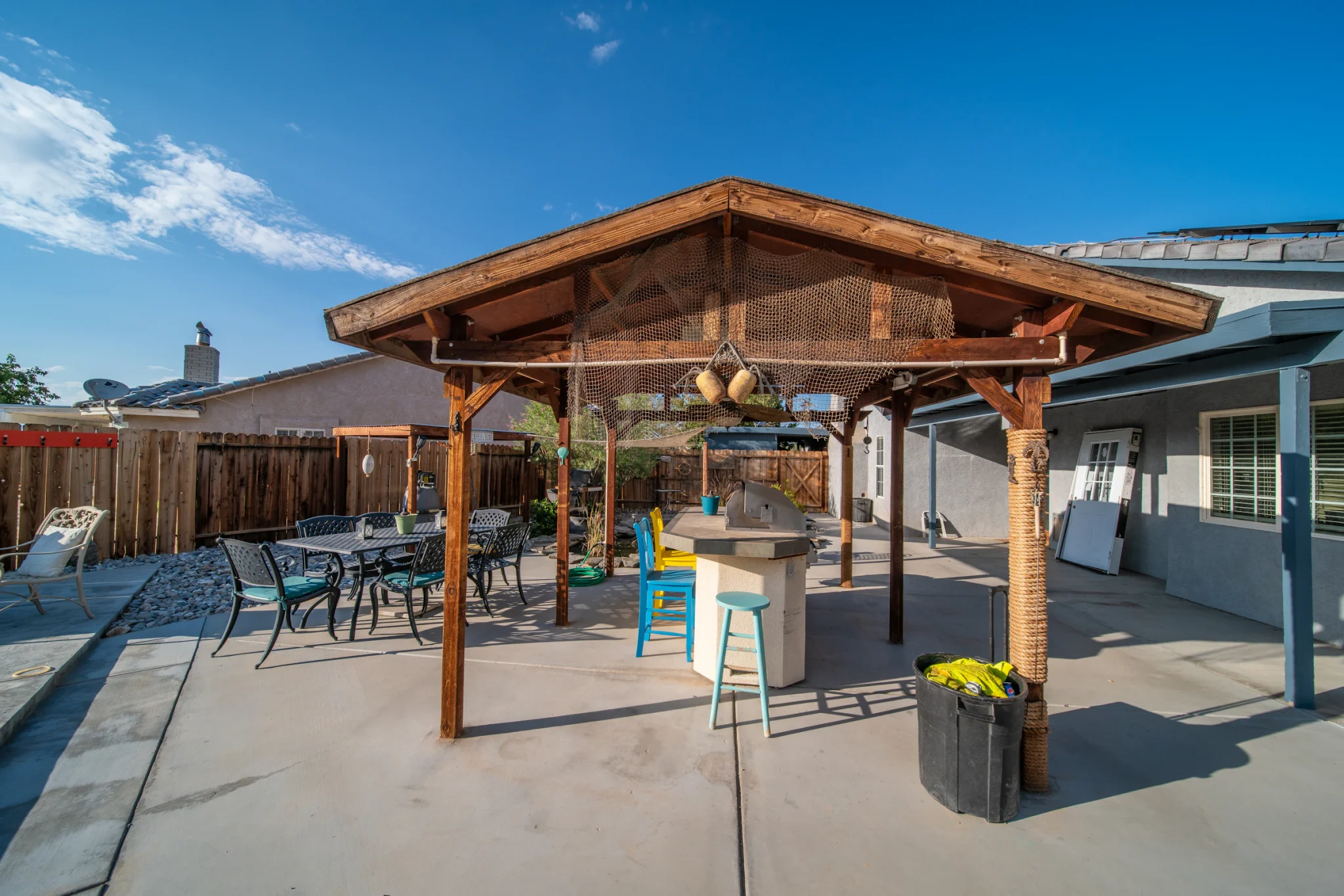
One of the earliest decisions in planning a pergola is whether it will attach to your house or stand independently. Each has real advantages.
Attached pergolas
An attached pergola is supported by posts on the outer side and connected to the house on the other, usually with a ledger board fastened to the wall framing.
Advantages
- Extends an indoor room outdoors, creating seamless flow from a kitchen or family room.
- Uses fewer posts, leaving more open floor space.
- Shades doors and windows on that side of the house.
Considerations
- Requires a sound structural connection and proper flashing to keep water out of the wall.
- Eave height, gutters, stucco or siding and roof slope can complicate the design.
- Attached structures generally receive closer permit review.
Freestanding pergolas
A freestanding pergola has posts on all corners, each on its own footing, independent of the house.
Advantages
- Can go anywhere: over a lounge, by the pool, at the end of a path or in a garden corner.
- Avoids working around eaves, gutters and exterior wall finishes.
- Creates a destination that draws people into the yard.
Considerations
- More posts and footings.
- May need more careful thought about how it relates visually to the house.
- Setbacks from property lines and other structures still apply.
Which is right for you?
Choose attached if you want the pergola to function as an extension of the house. Choose freestanding if you want flexibility in placement or a separate outdoor room. Many backyards benefit from one of each: an attached structure off the kitchen and a freestanding pergola or gazebo elsewhere.
Learn more on our pergola installation page.
Details that matter for attached pergolas
The ledger, the board that connects the pergola to the house, must fasten into structural framing, not just stucco or trim, and be properly flashed so water can’t get behind it. Eave height matters too: if the eaves are low, there may not be enough height to slope the pergola away from the house while keeping comfortable headroom. In those cases, a freestanding pergola placed close to the house, or a design that mounts above the roofline, can be a better solution.
Details that matter for freestanding pergolas
Because every post carries load, footings and bracing are especially important for freestanding structures. Placement should consider setbacks from property lines, distance from the house and other structures, drainage, tree roots and how the pergola looks from inside the house.
A hybrid option
Some homeowners choose a freestanding pergola set just off the house. It feels connected without touching the walls, which can simplify detailing on stucco homes or houses with complicated rooflines.
Frequently asked questions
Is one cheaper than the other?
Attached pergolas use fewer posts but need careful connection work; freestanding pergolas need more posts and footings. The difference depends on the specific design and site.
Which needs a permit?
Requirements depend on your city and the structure. Attached structures typically receive closer review.
Talk it through with GaziBoys
Every backyard is different, and the best answer for your home depends on your space, your sun exposure and how you want to use it. GaziBoys is based in Burbank and works with homeowners across Greater Los Angeles. Request a free estimate or call (747) 344-7727 to talk about your project.